
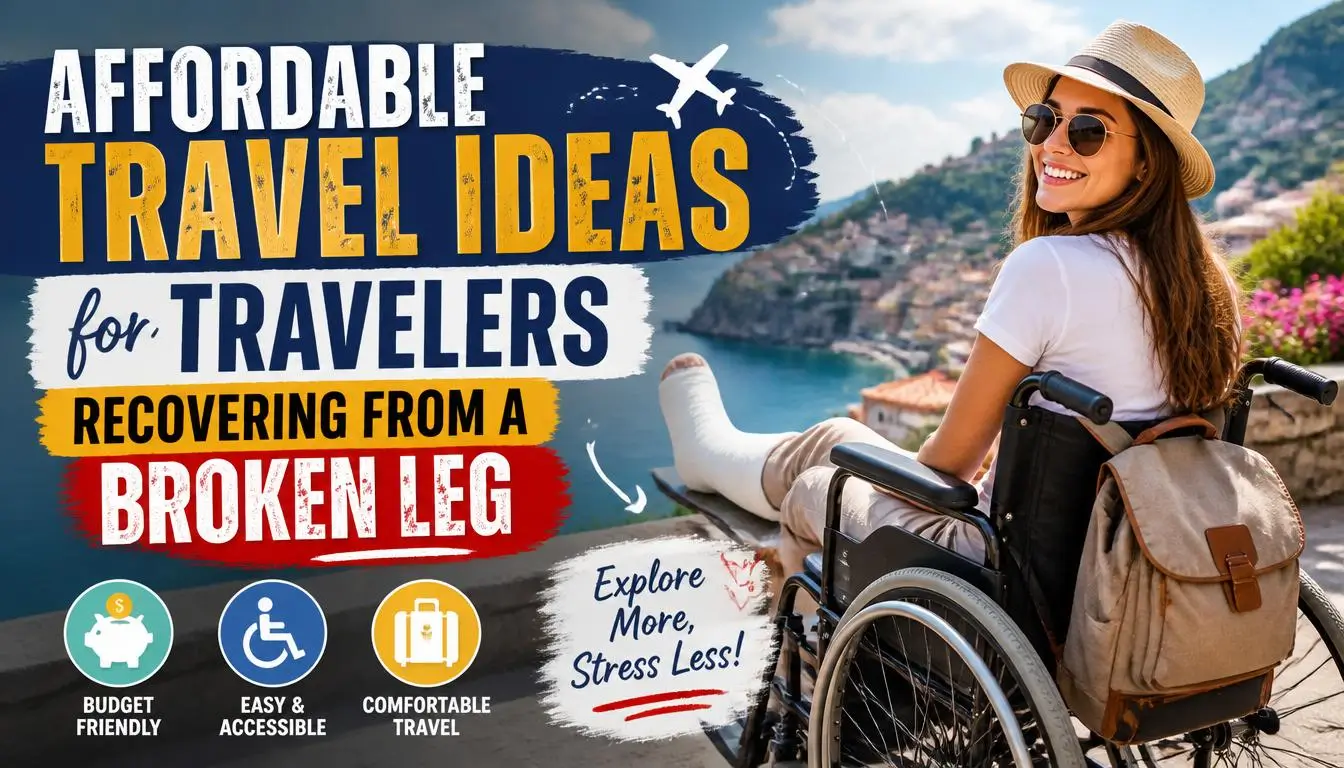
Finding affordable travel ideas for travelers recovering from a broken leg feels impossible when every standard travel tip assumes you can walk indefinitely, carry your own luggage, and navigate stairs without a second thought. I broke my fibula badly enough to require surgery and spent four months in various stages of non-weight-bearing, partial weight-bearing, and walking-boot recovery. I took three trips during that period. Not because I’m reckless, but because staying home staring at my ceiling while everyone else lived their lives was making my mental health measurably worse than my physical health. These ideas and strategies actually worked during real recovery, not theoretical recovery where everything goes smoothly.
Get Medical Clearance That’s Specific to Your Travel Plans
General medical clearance for travel isn’t sufficient when you’re recovering from a broken leg.
Your orthopedic surgeon or physiatrist needs to know specifically what you’re planning to do and where you’re planning to go. Not “I’m thinking about traveling.” Specifically: “I want to take a four-day trip by car to a beach destination. I’ll be in a walking boot. I plan to spend most of my time seated or using a mobility aid. The furthest I’d need to walk is about 100 feet at any point. Is this safe given my current healing status?”
Specific plans get specific answers. Vague questions get vague answers that don’t actually help you make a safe decision.
My surgeon’s clearance for my first trip (six weeks post-surgery, non-weight-bearing) came with specific conditions:
Elevate the leg for at least 30 minutes every two hours.
No air travel until week eight due to deep vein thrombosis risk.
Keep surgical incision areas dry and covered.
Have the name and number of an orthopedic urgent care facility at the destination.
Return immediately if swelling increased dramatically or pain became unmanageable.
These conditions shaped every aspect of how I planned the trip. They also gave me genuine confidence that traveling was medically reasonable rather than something I was doing against medical advice.
Get clearance. Get it specific. Get it in writing if your travel insurance requires medical documentation.
Choose Road Trips Over Flying During Early Recovery
Flying during early broken leg recovery creates several simultaneous problems that road trips avoid entirely.
DVT risk: Prolonged immobility in cramped airplane seats increases deep vein thrombosis risk significantly. Broken leg recovery already elevates DVT risk independently. Combined, the risk profile during early recovery often makes flying medically inadvisable until healing reaches a certain stage. My surgeon specifically prohibited flying until week eight for this reason.
Elevation impossibility: Broken legs need frequent elevation to manage swelling. Elevating properly in a standard airline seat is effectively impossible. Road trips allow stopping every 60 to 90 minutes, getting out, and elevating the leg properly.
Luggage management: Navigating airports with a broken leg while managing luggage is genuinely difficult even with wheelchair assistance. Loading and unloading a car is manageable with a traveling companion or simple logistics.
Flexibility: Road trips allow pace adjustments in real time. If your leg hurts, you stop sooner. If you’re tired, you rest. If you need to find a pharmacy, you pull over. Airlines run on their own schedules regardless of your comfort.
Cost: Road trips eliminate flight costs entirely, often the most expensive component of a trip. With a broken leg already generating medical bills, eliminating the most expensive travel cost matters.
I drove to three different beach destinations during recovery. Each time my traveling companion drove while I kept my leg elevated on a pillow in the passenger seat. We stopped every 90 minutes. The trips were completely manageable.
Rent Vacation Properties with Specific Accessibility Features
Standard hotel rooms create daily problems for broken leg recovery that vacation rentals with the right features eliminate.
What to look for:
Single-story properties with no interior stairs. Negotiating stairs on crutches or in a walking boot multiple times daily is exhausting, risky, and slows recovery. A single-story house, cabin, or ground-floor condo eliminates this entirely.
Ground floor location with step-free entry. Even one step at the front door becomes a significant obstacle with crutches. Properties with completely flat entries to the front door and all exterior areas matter.
Walk-in shower rather than tub-shower combination. Getting in and out of a tub with a broken leg is both difficult and risky. Walk-in showers with a shower bench allow safe, manageable bathing.
Wide doorways throughout. Crutches add about 18 inches to your effective width. Narrow doorways become obstacles. Standard accessible doorway width (32 inches minimum) accommodates crutches comfortably.
Furniture at appropriate heights. Deep, low sofas are extremely difficult to get in and out of with crutches or a walking boot. Firm chairs with arms at standard height are far more manageable.
Covered outdoor seating. You’ll spend significant time seated outdoors during recovery trips. Covered seating protects you from elements without requiring mobility to seek shelter.
Where to find these properties:
Airbnb’s accessibility filter allows selection of step-free access, wide hallways, and accessible parking simultaneously. Message hosts directly to confirm specifics before booking.
VRBO hosts are often responsive to direct accessibility questions before booking.
Booking.com’s accessibility filter for hotels and apartments includes specific feature selections.
Before booking, message directly and ask:
“How many steps are there from the parking area to the front door?”
“Is the shower a walk-in or tub-shower combination?”
“Are there any interior stairs between rooms?”
“Is there outdoor seating where I can keep my leg elevated?”
Hosts who answer specifically and quickly are reliably describing their property accurately. Vague answers warrant follow-up questions or choosing a different property.
Pack a Personal Recovery Kit That Travels with You
Your broken leg recovery routine doesn’t pause because you’re traveling. The supplies that manage your daily recovery need to come with you.
My travel recovery kit:
Elevation supplies:
Two firm pillows specifically for leg elevation (hotel and rental pillows are often too soft to maintain proper elevation angle).
A foam wedge elevator if you’re in a stage requiring specific elevation angles.
Comfort and pain management:
All prescribed medications in original labeled containers with a doctor’s letter.
Over-the-counter backup: ibuprofen and acetaminophen.
Ice packs: reusable gel packs that can be frozen in any accommodation’s freezer.
Heating pad with universal adapter if traveling abroad.
Mobility aids:
Your crutches, walking boot, or whatever mobility aid you’re currently using.
A rolling knee scooter if you’re in a non-weight-bearing phase and will be covering distances. Knee scooters are transformative for recovery travel and significantly less exhausting than crutches for longer distances.
A transport wheelchair for destinations involving extended distances.
Wound and incision care:
Any prescribed wound care supplies.
Waterproof cast or boot covers for showering (Seal-Tight and DryPro both make reliable options at $25 to $40).
Extra bandaging supplies.
Swelling management:
Compression socks for the recovering leg (if cleared by your surgeon).
A portable footstool or ottoman for seated elevation at restaurants and activity locations.
Everything fits in one dedicated bag. This bag travels in the car or as carry-on luggage. Never in checked luggage where you can’t access it during travel.
Plan Activities Around Seated and Low-Mobility Experiences
The mental shift required for broken leg travel is moving from “what can I see” to “what can I genuinely experience from a seated or low-mobility position.”
This reframe opens more options than it closes.
Experiences that work excellently during recovery:
Boat tours and cruises. You board once, you sit, the scenery comes to you. River cruises, harbor tours, whale watching trips, sunset sailing excursions. The water brings the experience to you without requiring you to bring yourself to it.
Winery and brewery visits. Most wineries have tasting rooms designed for seated experiences. You drive to the winery, you’re seated for the tasting, you drive to the next. This is actually how wineries are supposed to be experienced.
Scenic drives. Some of the most extraordinary landscapes in the world are accessible from a car window. Highway 1 in California. The Blue Ridge Parkway. The Going-to-the-Sun Road in Glacier National Park. Crater Lake’s rim drive. You experience extraordinary scenery without leaving your car.
Food experiences. Cooking classes (seated prep, seated eating), food tours in flat areas with frequent stops, restaurant meal experiences, farmers markets where you can move slowly on your own schedule.
Museum visits with wheelchair or mobility aid. Most major museums offer complimentary wheelchair loans. You see the same collection as everyone else without the physical demand. Call ahead to confirm wheelchair availability and accessible routes.
Beach and waterfront stays. You set up once with a chair and elevation pillow and the beach comes to you: waves, light, air, temperature, and atmosphere without requiring you to walk anywhere after your initial setup.
Spa and wellness days. Many spas specialize in exactly the kind of seated, low-activity experience that broken leg recovery allows. Not a luxury indulgence in context: an appropriate, medically compatible, genuinely restorative experience.
Drives through charming small towns. Park in the most central location possible, walk (or scooter) a short flat distance to a main street, sit at a café, observe the town from one vantage point. Less coverage than a healthy traveler achieves, but genuine immersion in a place.
Use a Knee Scooter Instead of Crutches for Travel
If you’re in a non-weight-bearing phase, the knee scooter is the single most impactful equipment upgrade for travel.
Crutches are exhausting. They require upper body strength and coordination simultaneously. They’re unstable on uneven surfaces. They free no hands for carrying anything. Over a full travel day, crutch fatigue limits mobility to a fraction of what a knee scooter allows.
A knee scooter:
Allows hands-free movement.
Covers ground significantly faster than crutches.
Requires far less upper body effort.
Reduces overall fatigue dramatically.
Folds compactly for car travel.
Generates far less armpit and wrist pain than extended crutch use.
Rental options make knee scooters affordable for travel:
Scootaround and 1800wheelchair.com both offer knee scooter rentals delivered to hotels and vacation rentals nationwide for $40 to $60 per week. Renting at the destination rather than transporting from home is the most practical approach.
Airport and cruise terminal rentals: Many major airports and cruise terminals rent mobility equipment including knee scooters. Check availability before your trip.
Local medical supply stores: Most cities have medical equipment rental companies that rent knee scooters for $30 to $50 per week with delivery.
I rented a knee scooter for my second recovery trip and covered three times the ground I’d managed on crutches during my first trip, with significantly less pain and exhaustion. The $45 rental fee was the best money I spent on any of my three recovery trips.
Find Flat Destinations Deliberately
Terrain matters enormously for broken leg travel in ways that only become obvious when you’re navigating it on crutches or a scooter.
Cobblestones are essentially impassable on a knee scooter and genuinely painful on crutches. Steep hills require exponentially more effort and stability than flat surfaces. Unpaved paths and gravel are mobility aid hazards.
This isn’t a reason to stay home. It’s a reason to choose destinations where terrain works for your current mobility level.
Terrain-friendly destination types:
Flat coastal towns: Beach towns built on flat ground with wide boardwalks and paved access paths. Gulf Shores, Alabama. Myrtle Beach, South Carolina. Clearwater Beach, Florida. These are designed for beach chairs and slow movement.
Purpose-built resort areas: Resort strips with wide, flat, paved walkways between accommodation, restaurants, and beach access. International Drive in Orlando. Destin’s Emerald Coast resort corridor.
River and lake towns with flat waterfronts: Savannah’s waterfront. The Wisconsin Dells. Lake Tahoe’s flat lakefront areas.
Wine regions with drive-between-winery models: Napa Valley. Texas Hill Country. The Willamette Valley. You drive between destinations rather than walking between them.
National Park visitor center experiences: Many national parks have visitor centers, scenic overlooks, and short paved accessible trails that provide genuine park experience without demanding terrain. The South Rim of the Grand Canyon has paved accessible overlooks. Yosemite Valley floor has accessible paths. Crater Lake’s rim drive has accessible overlooks.
Research terrain specifically before choosing any destination. “Is the main area flat and paved?” is a direct question worth asking local tourism offices or destination-specific Reddit communities before booking.
Budget Specifically for the Additional Recovery Travel Costs
Broken leg travel costs more than regular travel in specific ways that budget planning needs to account for.
Additional costs to budget:
Knee scooter or mobility aid rental: $40 to $80 per week.
Wheelchair assistance at airports if flying: Free service but tip airport wheelchair assistants $5 to $10.
Accessible parking: Often free with a temporary disabled parking permit (get one from your DMV before traveling, the process takes a few days).
Waterproof cast or boot cover: $25 to $40 one-time purchase.
Accessible accommodation premium: Properties with step-free access and walk-in showers sometimes cost 10 to 20% more than non-accessible equivalents.
Additional medical supplies: Budget $30 to $50 for medications, wound care supplies, and ice packs.
Potential urgent care visit: Keep $200 to $300 available for an unexpected medical visit at the destination.
Costs that offset these additions:
No paid activities involving significant walking (hiking tours, walking tours, physically demanding activities) reduces activity budget significantly.
Lower food budget if you’re resting more and have accommodation with a kitchen.
No checked luggage fees if your mobility aids travel free (airlines must accommodate mobility equipment at no charge under DOT regulations).
The net additional cost of recovery travel compared to regular travel is typically $100 to $300, not thousands. Budget for it specifically rather than hoping it evens out.
Apply for a Temporary Disabled Parking Permit Before You Leave
This takes 10 to 15 minutes at your local DMV and dramatically changes the logistics of recovery travel.
Temporary disabled parking permits are issued for recoveries from injury, surgery, and temporary mobility limitations. Most states issue them for periods of one to six months depending on expected recovery duration.
What a temporary disabled parking permit provides during travel:
Access to disabled parking spaces at every destination: museums, restaurants, beaches, shopping areas, national park lots, everywhere.
Closer parking that reduces the walking distance between your car and any destination dramatically.
Free parking in metered spaces in many states and municipalities.
Priority parking at airports, cruise terminals, and major attractions.
The difference between parking 50 feet from a restaurant entrance and 400 feet from a restaurant entrance is enormous on crutches or a knee scooter. Multiply this across every stop on a multi-day trip and the parking permit saves significant physical energy and pain.
Most DMVs issue temporary permits with a doctor’s documentation letter. Your orthopedic surgeon can provide this letter. Some DMVs have online applications. Processing typically takes a few business days.
Get this permit before your first recovery trip. It costs nothing and changes mobility logistics significantly.
Consider All-Inclusive Resorts as a Recovery Travel Option
All-inclusive resorts sound like a budget contradiction, but for broken leg recovery specifically, they sometimes make financial and practical sense.
The all-inclusive model provides:
Everything in one location: accommodation, all meals, drinks, entertainment. Minimal travel between destinations required.
Resort-wide flat and paved pathways designed for easy navigation.
Pools and beach areas accessible from accommodation without significant travel.
On-site medical staff familiar with guest medical situations.
No decisions about where to eat, how to get there, or what to spend on each meal.
The cost comparison works sometimes: an all-inclusive resort at $150 to $200 per person per day includes three meals, drinks, entertainment, and accommodation. Breaking this down separately (hotel $100, three restaurant meals $60 to $80, drinks $30 to $50) often approaches or exceeds the all-inclusive cost without the logistical simplicity.
For recovery travel where every movement requires planning and effort, simplicity has genuine value.
Not all all-inclusive resorts are accessible. Research specifically whether the resort has:
- Step-free beach access
- Accessible pool entries
- Ground floor room availability
- Wide pathway infrastructure
Excellence Playa Mujeres, Sandals Royal Barbados, and Beaches Turks and Caicos all have accessible infrastructure worth researching for recovery travel specifically.
Frequently Asked Questions
How soon after breaking a leg can you travel safely?
This depends entirely on fracture severity, treatment type (cast versus surgery), and individual healing progress. Some people travel within weeks of a minor fracture. Others need months before travel is medically appropriate. The only person who can answer this for your specific situation is your orthopedic surgeon with full knowledge of your injury details, healing progress, and specific travel plans. Don’t rely on general timelines for this decision.
What are the best affordable travel ideas for travelers recovering from a broken leg who can’t fly yet?
Road trips to destinations within four to six hours by car work well during the period when flying isn’t medically cleared. Beach towns with flat terrain, lakehouse rentals, wine country driving routes, and cabin stays all work excellently. Focus on destinations where the experience involves being somewhere beautiful rather than navigating between multiple locations. The car gives you elevation flexibility, stop-whenever-needed convenience, and eliminates airport logistics entirely.
Can airlines accommodate broken leg recovery travel?
Yes, with advance planning. Request wheelchair assistance when booking, not at the gate. Request a bulkhead or exit row seat for legroom (though exit row comes with safety responsibility requirements that may conflict with mobility limitations). Request priority boarding. Inform the airline of your medical equipment (crutches, walking boot) when booking. Airlines must accommodate mobility aids and medical equipment at no charge under DOT regulations. Confirm all accommodations 48 hours before departure.
Is travel insurance worth purchasing during broken leg recovery travel?
Absolutely essential, not optional. Purchase a policy that covers pre-existing and current medical conditions explicitly. Read the fine print: many policies exclude injuries being actively treated. Look for policies covering emergency medical care at the destination, trip cancellation due to medical deterioration, and medical evacuation. Allianz and Travel Guard both offer policies that can be structured to cover active injury recovery. Expect to pay slightly more for coverage that explicitly includes current injury status.
What’s the best mobility aid for travel during broken leg recovery?
Knee scooters are the best option for non-weight-bearing phases covering any meaningful distance. They’re faster than crutches, less exhausting, and allow hands-free movement. Transport wheelchairs are best for extended distance travel (airports, large museums) where a companion can push. Standard crutches remain necessary for stairs and terrain that scooters can’t handle. Having both a knee scooter (rented at destination) and crutches (for specific situations) covers the full range of recovery travel mobility needs most effectively.
Conclusion
A broken leg doesn’t cancel your life for three to six months. It changes the parameters within which you live it, which is a different and more manageable problem than it initially feels like from a hospital bed. The trips I took during recovery weren’t the same as my pre-injury trips. They were slower, more seated, more deliberately planned, and in some ways more genuinely present because I couldn’t rush through anything even if I’d wanted to. Where could you reasonably get to within a few hours that would make the next month of recovery feel less like waiting and more like living?